
Independent browser-game field notes
Pet Card Sort Field Guide: Triple Matching, Hidden Layers, and Slot Discipline
A hands-on guide to the verified three-bee clear, the shark-and-cat reveal beneath it, double-page scanning, safe triple planning, focus recovery, and the boundaries of the short Level 1 test.
View provider sourceOpens the attributed provider page. NovarGame does not embed this third-party runtime or claim to operate the game.
What the game is really about
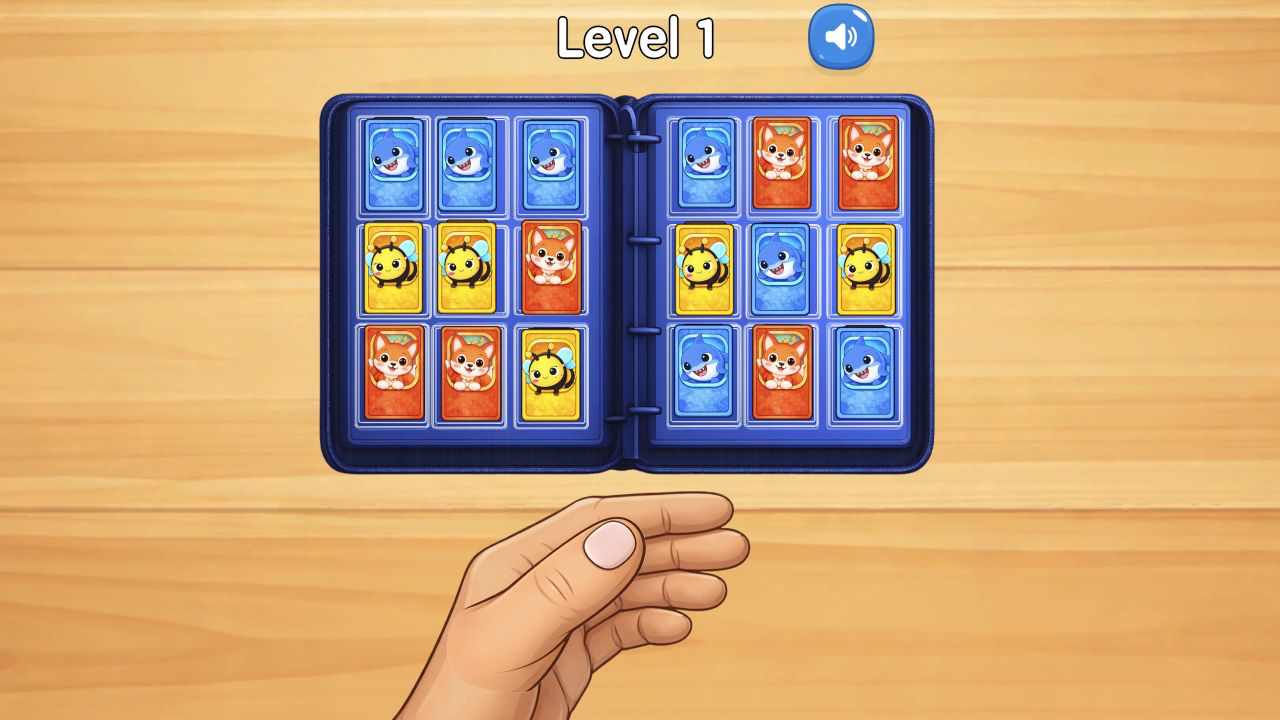
Pet Card Sort looks cheerful because the cards feature cute animals such as owls, bunnies, and colorful fantasy pets, but the underlying puzzle is about space management. The recorded opening board showed cards on two album pages. Selecting three exposed bee cards cleared the set and revealed shark and cat cards underneath. Full-board completion was not tested.
The provider describes a limited-slot matching puzzle, but the retained session did not fill those slots or trigger overflow. Slot pressure below is general matching-game advice rather than a verified failure rule for this opening board. A good player treats every slot as temporary storage and asks how each placement moves the board closer to a three-card clear.
The double-sided board gives the game an extra layer. You need to think about what is available now, what might be waiting on the other side, and how much space you can afford to reserve for future matches. The cute theme makes the game relaxed, but the decisions are real.
How to start a level
Begin by scanning for pets that already have two visible copies. Those are strong candidates because one more card can clear a set and free space. Then look for pets with only one copy visible. They may be worth delaying unless you have enough open slots to hold them safely.
Do not fill every slot just because you can. Empty space is your safety net. If you keep one or two slots open, you can respond when a useful card appears. If the board is full of unmatched singles, even an obvious future match can become unreachable.
When the game asks you to clear both sides, remember that progress on one side can create pressure on the other. Try to complete sets in a way that keeps the board flexible. A clean triple is better than three partial plans that all need the same final slot.
General matching advice beyond the recorded triple
Group similar pets mentally. If you place two owl cards, remember that the next owl has priority because it turns storage into a clear. If you place one bunny and one sloth, do not keep adding unrelated singles unless the board has enough space. The more unfinished groups you create, the harder the puzzle becomes.
It also helps to think in turns: select, place, match, release space. If a move does not bring you closer to that cycle, ask whether it is necessary. Sometimes the best move is not the most colorful card but the one that removes a set and gives you room to breathe.
The provider lists desktop and mobile support. NovarGame verified only the desktop runtime and does not claim tested mobile input quality. On a smaller display, similar animal shapes and colors are the details most likely to need a slower comparison.
Sharper decisions
The mistake that causes trouble is collecting too many different pets at once. This feels productive because the board is active, but it creates a traffic jam. Another mistake is ignoring a near-complete set while chasing a new card type. In limited-slot puzzles, finishing a set is often more valuable than starting another one.
Players may also forget to check both sides of the board before committing. If one side contains the final copy of a pet, storing its pair safely becomes more important. Good sorting depends on memory as much as matching.
Use a commitment ladder before every pick
Classify a visible card before selecting it. A “clear now” card completes a triple already represented in storage and deserves top priority. A “pair builder” creates two copies of one pet and is usually useful when a third copy is visible on either page. A “speculative single” has no visible partner and consumes flexibility. Select speculative singles only when they uncover important cards or when the holding area has comfortable spare capacity.
The recorded bee move illustrates the safest case. All three target cards were already exposed across the two pages, so the sequence could be planned from start to finish before the first selection. When the third bee cleared the set, three underlying positions changed at once: two sharks and one orange cat appeared. That is more valuable than a cosmetic removal because it reveals the next decision layer.
Re-scan after every reveal
Do not continue an old plan automatically after a triple disappears. The new shark pair immediately changes the board: a card type that may have been speculative before the clear is now two-thirds complete. The cat is a different kind of lead—one visible copy that should be remembered but not necessarily collected at once.
A useful re-scan has four steps: count empty holding positions, identify any pair already waiting, compare newly exposed cards on both pages, and choose the shortest route to the next full triple. This prevents momentum clicking, where a player keeps selecting attractive cards even though the board has presented a safer set.
Separate board progress from storage pressure
Removing a top card advances the visible stack, but selecting that card can still worsen the holding area. Those are different resources. Board progress reveals information; empty storage preserves choices. A strong move improves one without damaging the other too much. A weak move uncovers a card but leaves several unrelated singles occupying the slots.
When two moves reveal similar depth, prefer the one that completes or extends an existing pair. When one move uncovers several cards at once—as the bee triple did—it can justify temporary storage because the information gain is large. The exact number of holding slots and the loss condition were not stress-tested, so this is a decision framework rather than a claim about a specific overflow threshold.
Recover from an apparent missed click
The first click after the provider advertisement did not select a card; it restored focus to the runtime. That failure matters because it can make a valid card appear unresponsive. If a click produces no highlight or storage change, click once inside a neutral part of the frame, then retry the intended card and watch for persistent feedback. Do not rapidly click several animals, because delayed input can create unwanted singles once focus returns.
If a selected card enters storage but its two partners do not clear the set, verify the artwork carefully. Similar colors are not proof of identity. The successful session used three unmistakable bee cards and judged completion by the changed positions beneath them, not by animation alone.
What the short test supports
The evidence supports four game-specific conclusions: Level 1 uses exposed cards on two album pages; a three-of-a-kind selection clears; cleared positions reveal stacked cards; and provider-frame focus can consume the first click. It does not support a claim that the whole board was cleared, that every level uses the same layout, that boosters are necessary, or that the mobile interface is comfortable.
That boundary still leaves a useful reader decision. Try Pet Card Sort if you enjoy planning complete triples, remembering both sides, and converting a reveal into the next short sequence. Look elsewhere if you want a reflex game, verified long-term progression, or proof that later levels stay fair without boosters.
Right audience
Pet Card Sort suits players who enjoy cute visuals, matching rules, and calm but meaningful decisions. It is a good browser puzzle for short sessions because the objective is clear, yet the slot limit gives it bite.
It is not a speed game. The fun comes from tidy planning: building triples, freeing space, and gradually clearing both sides without letting the board clog.
The important hook
Compare the result with Onet Puzzle: Pet Card Sort cleared three identical cards and exposed a hidden layer, while Onet cleared pairs along a connection path. Choose between them by whether you prefer uncovering stacked cards or reading open routes. Those differences were visible in the retained opening records; they are not a comparison of complete campaigns.
What happened in the recorded session
The desktop check reached Level 1 and selected three exposed bee cards across the two album pages. The first click after the provider advertisement only restored frame focus, so the sequence was repeated. When the third bee was selected, all three cards cleared. Two positions revealed blue shark cards and the third revealed an orange cat card underneath, confirming both the three-of-a-kind rule and the stacked-card reveal.
This visible change supports the guide's focus on planning beyond the current top layer. A match is valuable not only because it removes three cards, but because it exposes new information and changes which sets can be built next. The test did not intentionally fill the holding slots, so claims about the exact overflow condition remain outside the evidence.
Limits and reader decision
Only the first bee match was completed during a short desktop Chromium session with mouse input. Later stacks, full-board completion, slot overflow, boosters, difficulty, mobile controls, and provider advertising beyond the opening were not tested. Choose Pet Card Sort if cute presentation plus three-card sequencing appeals to you. Skip it if you need proof of long-term variety, a verified mobile experience, or a complete assessment of booster pressure.