
Free browser game and player guide
Arrows Escape: Collision-Free Puzzle Notes
A practical review of Arrows Escape, a calm arrow-order puzzle where the real challenge is seeing which move safely unlocks the next one.
Play Arrows EscapeOpens the Playgama-supplied game on a separate, ad-free runtime page.
The core idea
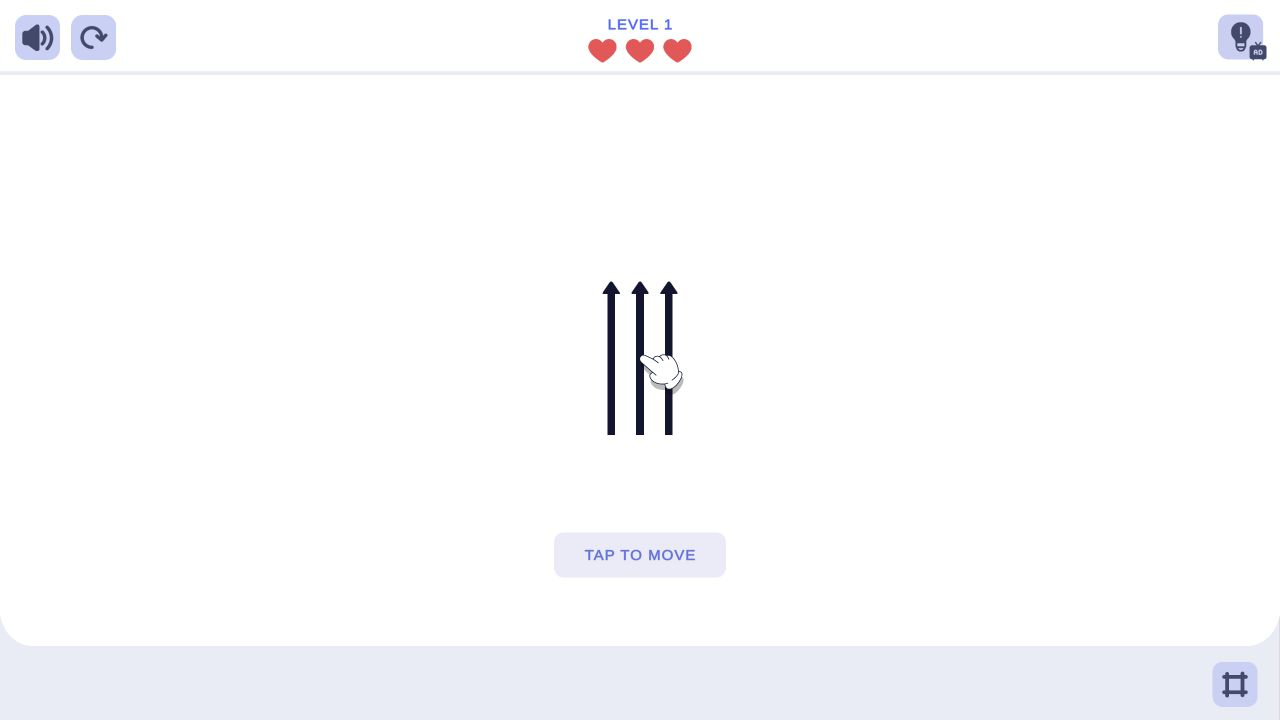
Arrows Escape is built around one clean rule: each arrow travels in the direction it points, and the board is cleared only when every arrow can leave without colliding. That single rule gives the game its value. There is no need for a long story or complicated upgrade system; the challenge comes from reading a small board carefully and choosing a move order that does not trap you later.
The most important thing to notice is that the first legal-looking move is often not the best move. A puzzle may contain several arrows that can leave immediately, but one of them might be holding the key to a different lane. If you clear the wrong space too early, you can leave another arrow with no safe path. That makes Arrows Escape less about tapping quickly and more about building a short plan before committing.
How to start without wasting hearts
Before tapping anything, scan the board edges. Any arrow that already points outward with a clear lane is a candidate, but do not move it yet. Next, find the arrows that are blocked by only one piece. Those are the ones that usually decide the shape of the puzzle. When a blocked arrow needs a specific lane opened, your first few moves should serve that purpose.
It helps to speak the order silently: "this one clears the row, that one frees the vertical arrow, then the corner can leave." If you cannot explain why a move helps, wait. The game is calm enough that patience is part of the skill. A hasty tap can turn a clean solution into a collision that feels avoidable the moment it happens.
What makes a good level
A good Arrows Escape board gives you a little uncertainty without hiding information. You can see all of the pieces. You can see their directions. The tension comes from consequences, not surprise. That is a healthy fit for browser play because a visitor can understand the task in seconds and still feel rewarded for thinking.
The optional hints also matter. They are useful for players who get stuck, but relying on them too early removes the strongest part of the game: the moment when the order finally becomes visible. I would use a hint only after checking the edge arrows, blockers, and possible collision lanes twice.
Device comfort
The provider presents the game as tap-controlled, which suggests a natural mobile fit, but NovarGame has not independently completed a mobile session. The verified desktop runtime uses the same deliberate one-move-at-a-time structure, and the larger screen makes it easy to trace an arrow path before selecting it. The controls are designed to feel deliberate rather than twitchy; this is a puzzle where precision is mental, not mechanical.
Good session choice
Arrows Escape suits players who like compact logic problems, tidy rules, and mistakes that can be understood immediately. It is not the right choice for someone looking for speed, combat, or dramatic progression. Its strength is quieter: each cleared board feels like a small piece of reasoning completed correctly.
That gives the game a clear role in the catalog. It represents a thoughtful puzzle option that is easy to open, easy to explain, and still specific enough to deserve its own player guidance instead of a generic "brain game" label.
Provider-listed controls
- Tap an arrow
- it slides straight in the direction it’s pointing until it leaves the grid (or would hit something)