
Independent browser-game field notes
Word Associations Solitaire: A Verified Burger 5/5 Route
A hands-on Level 1 record covering two opened themes, stock-pile cycling, five accepted Burger cards, and the completed foundation state.
View provider sourceOpens the attributed provider page. NovarGame does not embed this third-party runtime or claim to operate the game.
The verified Burger route
The September 17 desktop recheck reached Level 1 and opened two foundations: DOG 0/5 and BURGER 0/5. Five word cards were then accepted by BURGER: Patty, Bun, Sauce, Lettuce, and Cheese. The visible counter progressed through 1/5, 3/5, 4/5, and finally 5/5. At completion, the Burger foundation disappeared from the active area while DOG remained at 2/5.
This is the clearest rule the session established. A theme card creates a labeled destination, and ordinary word cards count only when the game accepts their relationship to that theme. The persistent counter—not pointer motion—is the reliable confirmation. The completed foundation leaving the board is a second, independent completion signal.
How the stock pile changed the route
Not every needed Burger card was immediately available. Advancing the stock pile exposed Lettuce, then Green, then Cheese in separate states. Lettuce and Cheese completed the last two confirmed steps; Green was observed but was not assigned to Burger. This means a stalled foundation does not necessarily imply that the category is wrong: the needed card may still be in the stock cycle.
The useful discipline is to read the current card before moving it. In this run, food-component words belonged with BURGER, while the visible animal cards advanced DOG to 2/5. Keeping both counters in view prevented a plausible-looking word from being counted merely because it moved under the pointer.
A practical opening sequence
First expose the theme cards so each destination has a name and target count. Next, place only the associations that are unambiguous. For the verified Burger group, Patty and Bun formed the clearest start, Sauce moved the counter to 3/5, and Lettuce plus Cheese completed the set. If the next card does not fit an open theme, cycle the stock pile and leave the active counters unchanged.
This is not a claim that Burger always appears in Level 1 or that the five cards arrive in the same order. It is a reproducible account of the board served during this session. The random-looking opening differed from the earlier August COLORS board, which is why the category label and target counter should be treated as the source of truth for the current round.
What the recheck corrected
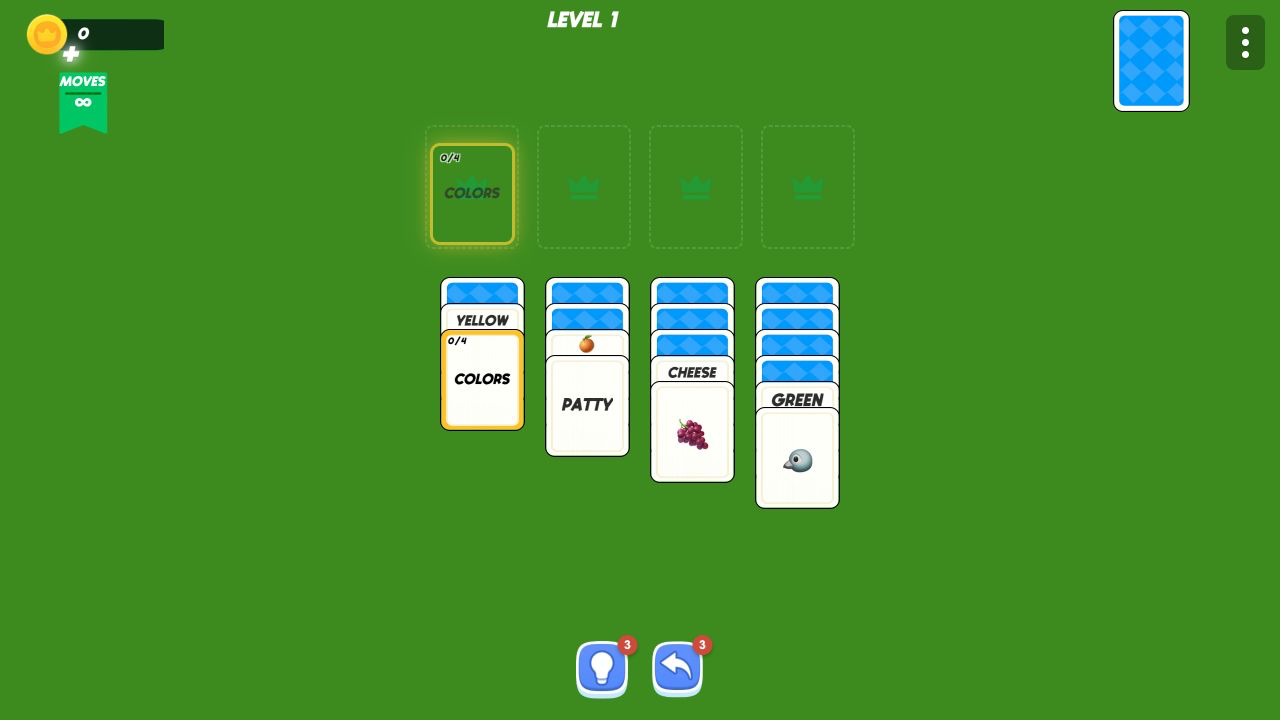
The earlier record verified only that COLORS 0/4 could be opened; Yellow and Green placement was inconclusive. The new session is materially stronger because it includes five accepted placements and a completed category state. The retained screenshot still documents the older opening state, so it must not be presented as a picture of Burger 5/5. The written September recheck is the evidence for the new route until a matching final-state image is captured.
An interstitial advertisement interrupted the run once, but the game recovered and retained visible category progress. That observation is about this provider session only. It does not establish a stable ad frequency, offline save behavior, or how the game handles a reload.
Reader decision and limits
Choose Word Associations Solitaire if you enjoy sorting ordinary words by meaning while managing a stock pile and several active themes. The completed Burger group shows that the game provides concrete progress feedback rather than relying on interpretation alone. It is more about semantic grouping than spelling or building a word letter by letter.
The recheck did not finish all of Level 1. DOG stopped at 2/5, rejection feedback was not deliberately tested, and hints, later themes, mobile input, and reward-related catalog metadata remain unverified. Because the imported metadata contains a reward-related signal that did not appear in the played round, advertising on this guide remains blocked pending provider clarification.