
Independent browser-game field notes
Onet Puzzle - Tile Match Game: A Clear Read on Connection Logic
Onet Puzzle - Tile Match Game is a compact tile-link puzzle about scanning calmly, preserving open lanes, and using tools only when the board is genuinely tightening.
View provider sourceOpens the attributed provider page. NovarGame does not embed this third-party runtime or claim to operate the game.
Why this tile matcher works
Onet Puzzle - Tile Match Game looks simple at first because the rule is easy to explain: find two matching tiles and connect them. The part that gives the game its staying power is the path rule. A pair is not enough by itself. The connection must travel through open space with a limited number of bends, so every successful match also changes the shape of the board for the next decision.
That turns the game into a quiet spatial puzzle instead of a pure memory test. You are not just asking, "Where is the other orange, shell, bird, or icon?" You are asking whether there is a route between the two tiles, whether removing them opens a better lane, and whether a tempting pair in the middle will leave the outer edges clogged. The best sessions have a pleasant rhythm: scan, test the route in your head, remove the pair, then immediately re-check the lanes that changed.
The game offers many visual themes and background music, which helps it feel more relaxed than severe. That matters because Onet is at its best when the player can stay patient. A crowded board punishes random tapping, but it rewards a steady eye and a willingness to solve the outside of the board before wrestling with the center.
How to approach the first few levels
Start by checking the corners and outside edges. Matches along the border are often easier because a connection can run around the outside of the tile block, and clearing them makes later interior matches less boxed in. If two identical tiles are visible but blocked by a wall of other tiles, leave them alone for a moment. There is usually a nearby pair that can open a lane first.
The game includes helpful tools, but they are most useful when you treat them as rescue options rather than routine moves. A hint can confirm a pair you overlooked, and a shuffle can break a board that has become too tangled. Using them early can feel convenient, but it also hides the lesson the board is trying to teach. Try to solve the first part of a level by observation, then spend a tool only after you have scanned the board in sections and still see no safe route.
The provider lists desktop and mobile support; NovarGame verified only the desktop runtime. The editorial recommendation on any listed device is to scan in rows or quadrants and pause after each clear, because useful connection lanes can change while the board still looks similar.
Errors worth fixing
An early mistake is matching the first visible pair without considering what it unlocks. A pair in the center may be legal, but an edge pair may be more valuable because it gives future lines a cleaner path. Another mistake is staring at one stubborn pair for too long. If the route is not there yet, move on and come back after two or three clears.
Players also lose time by scanning only for identical art and ignoring empty space. In this game, empty lanes are as important as the tiles themselves. Watch for horizontal corridors, vertical gaps, and border openings. When a new gap appears, re-check nearby pairs immediately because a connection that was impossible ten seconds ago may now be legal.
Player fit
Onet Puzzle - Tile Match Game suits players who enjoy calm pattern recognition with enough structure to feel purposeful. It is a good choice for short browser sessions because a level can be understood quickly, yet it still asks for real attention. It is especially satisfying for players who like puzzles that get better when they slow down.
It may not be the right pick if you want fast action or a dramatic story. The reward here is cleaner thinking: noticing a blocked pair, clearing the lane beside it, and watching the board open in a way that feels earned.
Why it works
The useful context is that the game is not just another match title. The limited-bend connection rule creates a specific kind of puzzle, and players should know that before opening it. The important skills are scanning order, lane management, tool restraint, and the ability to step away from a blocked idea. Those specifics show the listing more helpful than a thumbnail and a generic play button.
What happened in the recorded session
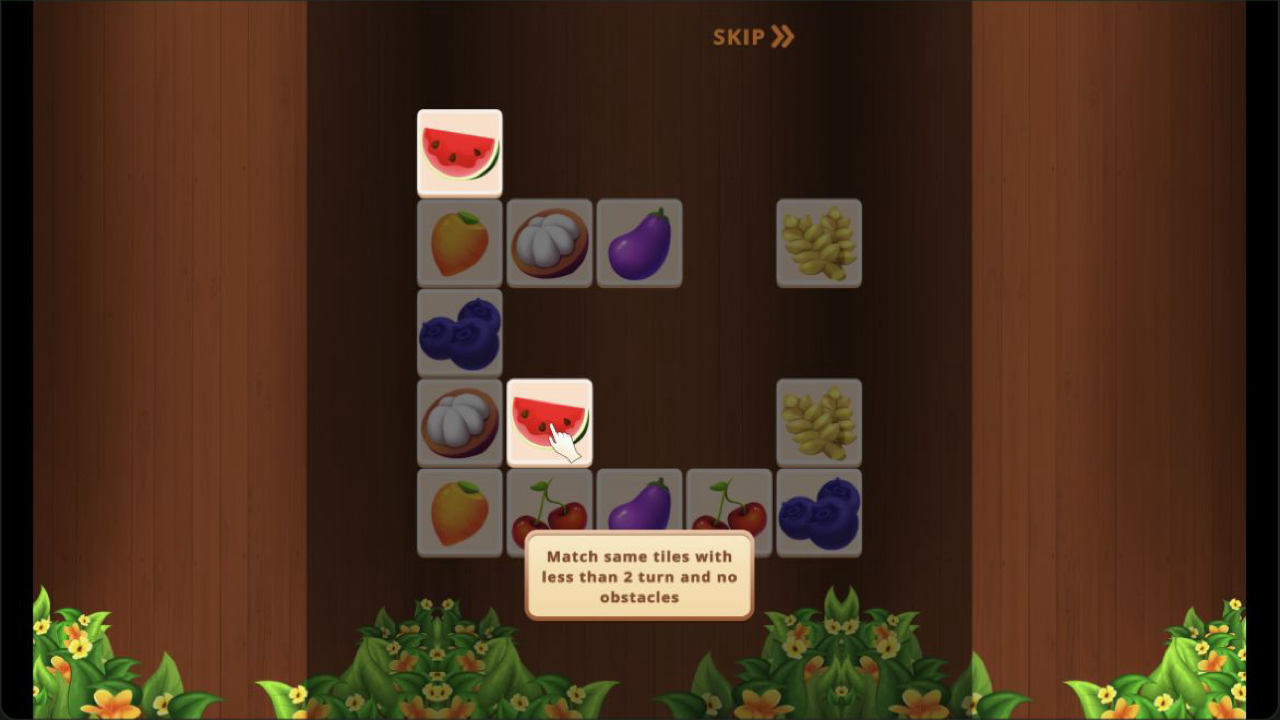
The desktop tutorial check removed three distinct fruit pairs. Two early clicks landed above the intended tiles and produced no move; after correcting the positions, the strawberry pair disappeared, followed by the banana pair and then the grape pair. Each removal changed the open lanes on the board. The tutorial then highlighted the connection rule: a valid route needs fewer than two turns and cannot pass through an obstacle.
This is stronger than a launch confirmation because the game accepted repeated matches and visibly changed the board after each one. It directly supports advice about scanning newly opened lanes. It does not show a full board clear or prove how strict the timer becomes later.
Limits and reader decision
The check covered about two minutes of tutorial play on desktop Chromium with mouse input. Hints, shuffle, timer behavior, later layouts, full-level completion, and mobile controls were not tested. Choose Onet Puzzle if you enjoy pattern recognition constrained by route geometry, especially when removing one pair creates the next opportunity. Skip it if you want pure memory matching without path restrictions or need a verified assessment of later difficulty and assistance tools.