
Independent browser-game field notes
Draw Bridge - Brain Game: Car Path Puzzle Guide
A focused guide to Draw Bridge - Brain Game, a physics puzzle about drawing safe routes so cars can cross obstacles and reach the goal.
View provider sourceOpens the attributed provider page. NovarGame does not embed this third-party runtime or claim to operate the game.
Drawing a bridge that actually works
Draw Bridge - Brain Game asks the player to draw a path for a car so it can cross gaps, avoid obstacles, and reach the destination. The action sounds simple, but the line behaves like a bridge, so shape matters. A path that looks clever may still fail if it is too steep, too short, or badly placed.
The game is a physics puzzle, not a racing game. The player does not win by accelerating harder. The important decision happens before the car moves: how should the bridge be drawn?
A tested first bridge, then hypotheses to try
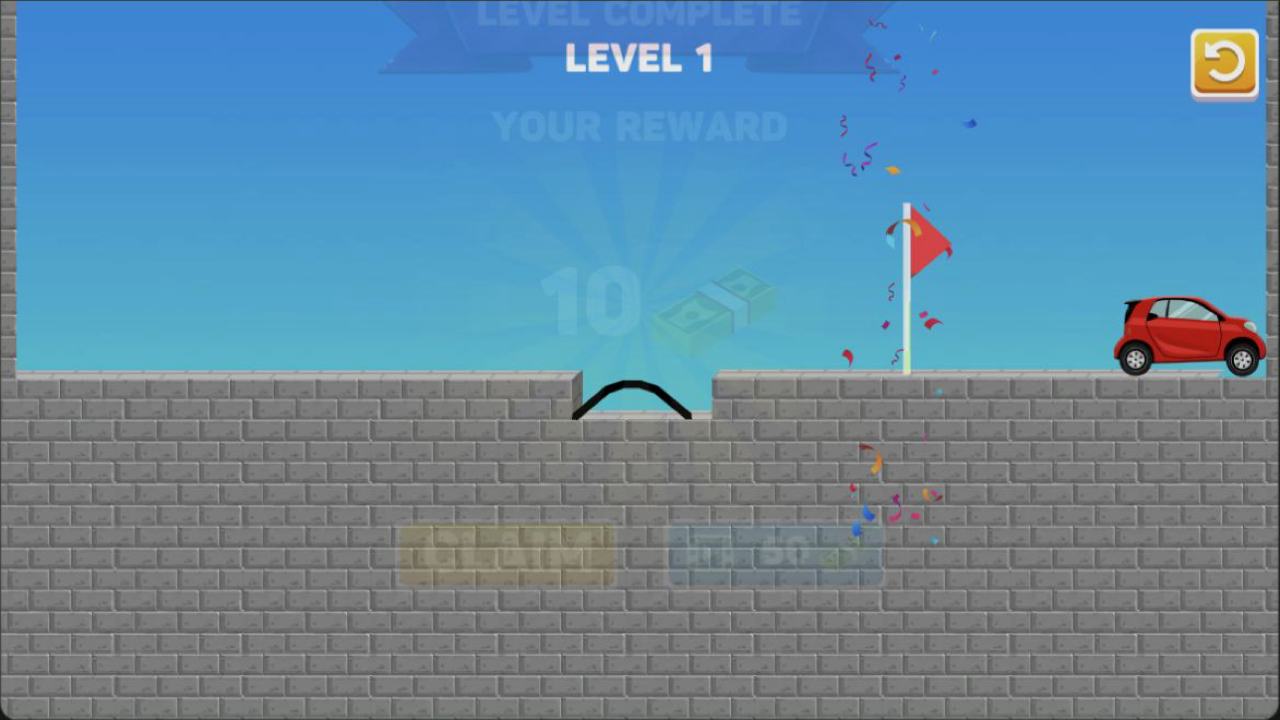
The tested Level 1 solution used a shallow arch anchored to both ledges. Start by looking at the car's start point, the gap, and the flag. The following failure explanations are physics hypotheses to try; the retained session did not compare steep, short and low bridges. The line should give the car a smooth approach, enough support, and a safe landing. A sharp angle, a low clearance or a steep landing are plausible causes to investigate if another attempt fails, but none was isolated in this opening test.
The best lines are often simple. A clean curve or ramp can be stronger than a complicated shape. If a level fails, change one part of the bridge and test again.
Why retries are useful
Use a failed bridge to form a hypothesis, not an immediate diagnosis. A fall could concern support or placement; a flip could concern the transition; stopping could have more than one cause. Change one part and compare the next result. Our observed failed input was loss of frame focus, not a demonstrated physics failure.
That is the value of the game: drawing is not decoration. It is problem-solving with immediate physical results.
Best way to play
The provider lists touch drawing on mobile and mouse drawing on desktop. NovarGame's evidence covers the desktop runtime only, so no first-hand mobile comparison is claimed. Tight gaps and narrow obstacle spaces are the situations where input precision matters most.
A vertical view can work for short stages, but the whole path should be visible before releasing the line. If the car's landing area is hidden, the puzzle becomes harder for the wrong reason.
Best use case
Draw Bridge - Brain Game suits players who enjoy physics puzzles, car-route challenges, and creative problem solving. It is not a driving simulator, even though a car is involved.
The most helpful replay goal is to make the bridge less dramatic and more reliable. A huge loop or strange shape may succeed once, but a simple stable bridge teaches the player more about the level. If the car reaches the goal smoothly, the solution was probably good.
Compare this with Single Line Drawing Puzzle: both use a continuous pointer gesture, but Draw Bridge asks whether the resulting surface carries a car, whereas Single Line checks coverage of a fixed graph. The distinction helps you choose between shaping a surface and following a route.
The observed loop is: inspect the obstacle, draw a stable bridge, watch the car, then revise the line until the route succeeds.
What happened in the recorded session
The desktop check moved beyond the title screen and completed the first level. After the opening provider advertisement was skipped, the first drag failed because the game frame did not yet have focus. The second attempt used a shallow arch anchored to both ledges. The black line became a solid bridge, the red car stayed upright, crossed the gap, passed the flag, and produced the Level Complete reward. That sequence confirms the advertised draw-and-test loop with a visible finish state rather than only confirming that the runtime loaded.
The useful lesson from that result is modest: a short, continuous line with a gentle approach was enough for the introductory gap. It does not prove that the same shape works later, and it does not justify claims about every hazard or physics edge case. It does show why controlled line shape matters more than decorative drawing in the opening puzzle.
Limits and reader decision
Only Level 1 was completed on a 1280×900 desktop Chromium session with mouse input. Longer spans, hazards, alternate solutions, later difficulty, mobile drawing, purchases, and provider advertising outside that session were not tested. Readers who need verified touch behavior should wait for a mobile check or verify it on the provider page. Choose this game if the idea of designing a route and then watching the physics resolve it sounds satisfying; skip it if you want direct vehicle steering or a review of long-term progression.