
Independent browser-game field notes
Mahjong Solitaire Zodiac Field Guide: Reading Open Pairs and Board Risk
A source-specific guide to the verified green-pair removal, layered zodiac layout, open-tile reasoning, move-value comparisons, dead-end prevention, and the limits of the short desktop test.
View provider sourceOpens the attributed provider page. NovarGame does not embed this third-party runtime or claim to operate the game.
Mahjong Solitaire Zodiac is calm but not automatic
The provider presents Mahjong Solitaire Zodiac as a classic solitaire-style tile game. The opening test confirmed one exposed pair; the following open-tile rule is classic/provider context, not a tested blocked-tile result. The player matches two identical open tiles and removes them from the board. A tile is open when nothing sits on top of it and at least one horizontal side is free. The objective is to clear the layout. The zodiac theme gives the boards a gentle identity, but the puzzle still asks for careful ordering.
The biggest trap is matching the first pair that appears. A pair may be legal but still poor if it removes tiles from an already open area while leaving stacked or blocked tiles untouched. Good play opens the board, exposes hidden layers, and preserves choices.
Classic pair-selection reasoning
As general Mahjong Solitaire strategy, prioritize pairs that free new tiles. The retained single-pair test does not demonstrate a complete solution for this particular layout. If one match opens a tall stack or releases a blocked row, it is usually more valuable than a match from the edge of an already loose area. The goal is not only to remove two tiles; it is to increase the number of future legal moves.
When the same tile appears in more than two places, compare positions before matching. Removing the easiest two may leave the harder two buried. Sometimes the better move is to use one easy tile with one blocked-side tile, opening a space that later solves another section.
Scan the entire board before selecting a tile. The provider lists mobile support, which NovarGame did not independently test; on any device, a slow visual sweep prevents many dead ends.
Playing for a cleaner clear
Try to work from the top down and from locked areas outward. Tiles on high layers often block several pieces underneath, so clearing them early helps reveal the board. Long rows can also be dangerous because a tile trapped between neighbors is not open. Matches that free row ends are often useful.
Relaxed play is part of the appeal, so the goal does not need to be speed. A thoughtful clear is more satisfying than a rushed board that ends with no moves. If the game offers hints or shuffle options, use them as learning tools. Notice which tiles were blocking progress so the next board can be read earlier.
Player recommendation
Mahjong Solitaire Zodiac suits players who like peaceful puzzles, matching rules, symbolic themes, and short brain-training sessions. The provider lists mobile and desktop support, while NovarGame's evidence covers the desktop runtime only.
Players who want action or heavy progression may find it too quiet. Players who enjoy scanning a board and gradually uncovering order should find the zodiac layouts relaxing.
A simple scan routine
A reliable scan routine makes Mahjong Solitaire Zodiac smoother. First, look for tall stacks because they hide the most information. Second, check long horizontal rows because they can trap otherwise useful tiles. Third, compare duplicate tiles and decide which pair frees the most space. This three-step scan takes only a moment, but it prevents many careless matches.
The zodiac theme can also help pacing. Treat the board as a calm visual pattern rather than a race. The game is at its best when the player settles into a slow rhythm of noticing, matching, and opening new choices.
Evaluate a pair by what it unlocks
When two legal pairs are visible, compare their consequences before choosing. Give the first point to a pair that removes a top-layer tile, a second point if it frees the side of a neighboring tile, and a third point if it reveals a symbol that already has a visible partner. A zero-point edge pair may still be safe, but it produces less information and less access than a pair that changes the center of the layout.
This is a planning aid, not a scoring rule observed inside the game. Its purpose is to turn “match identical tiles” into a repeatable decision. The retained session proves that an exposed identical pair can disappear and leave the surrounding layered circle in place. It does not prove that every visually matching pair is selectable, so a non-response should be treated as diagnostic information: one tile may be covered, both sides may be blocked, or the game frame may need focus.
Preserve duplicates when four copies are visible
Four identical tiles create two possible pairs, and the pairing order can decide whether a later copy remains trapped. Avoid automatically taking the two easiest copies. Instead, identify the most constrained tile—the one higher in a stack or tighter in a row—and pair it with an accessible copy if the rules allow. That leaves the remaining easy pair available for later.
With three visible copies, do not rush. Matching two may strand the third until a buried fourth appears. Ask which removal exposes more of the board and whether another symbol has a more urgent unlocking move. This duplicate management is the heart of solitaire Mahjong: immediate legality is not the same as long-term safety.
Diagnose a stalled board without inventing a rule
If two matching tiles do not clear, first confirm that both were selected rather than assuming the artwork differs. Then inspect vertical overlap and horizontal freedom. A tile can look exposed while a small portion is still covered, and a tile in a long row may have neither side free. Finally, remember the provider-frame issue recorded in the test: the first interaction after an advertisement may restore focus rather than select a tile.
Use visible feedback to separate those cases. A selection highlight on one tile but not the other points to legality or identity. No highlight at all points more strongly to focus. A successful match should create a persistent empty position, as the green-pair session did. Because hints, reshuffles, and no-move messages were not tested, this guide does not promise how the game resolves a true dead end.
A bounded quality verdict
The observed opening is readable, the selected green pair cleared cleanly, and the layered zodiac board supports deliberate scanning. Those facts justify calling the core pair-removal interaction functional. They do not justify claims about full-layout solvability, difficulty progression, shuffle fairness, or later-board variety. Players seeking a calm matching loop have enough evidence to decide whether to try it; players seeking a validated complete campaign do not.
What happened in the recorded session
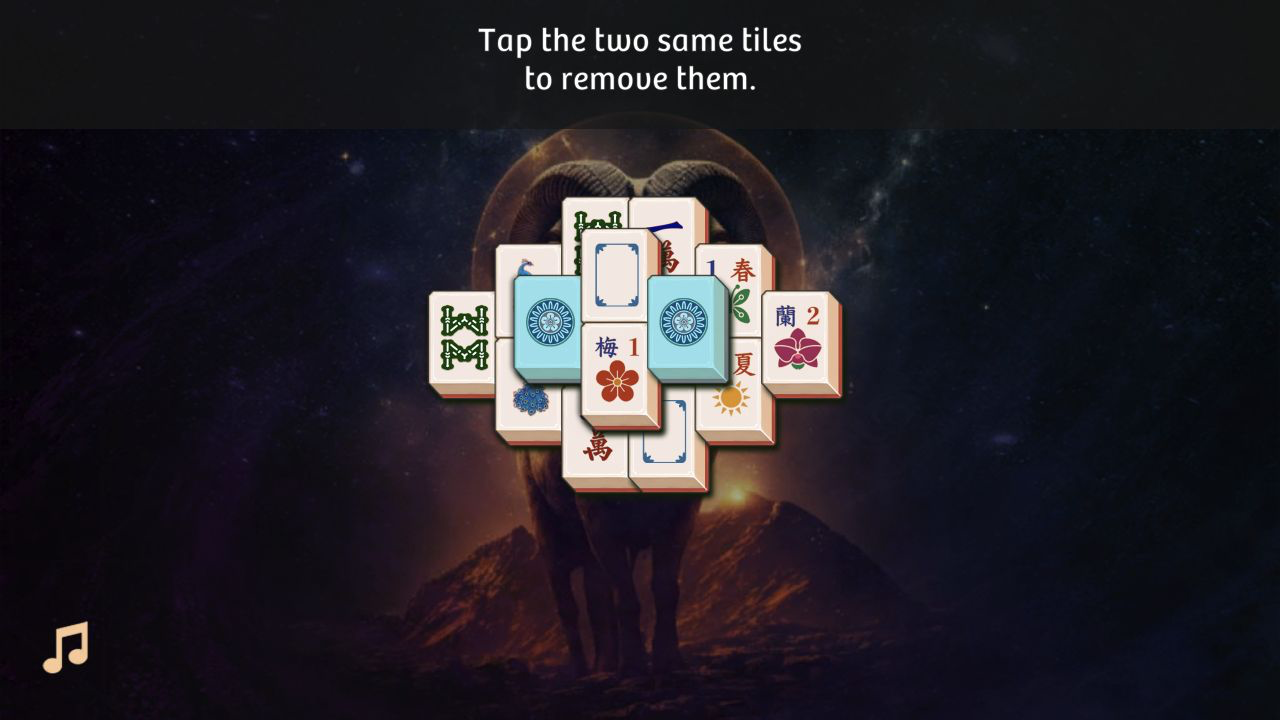
After the provider advertisement was skipped and the game frame was refocused, the desktop check selected two identical exposed green character tiles on the opening zodiac layout. Both tiles disappeared while the surrounding number and symbol tiles remained. The post-match board no longer contained the green pair that had been visible at the left and upper portions of the layered circle.
The result confirms selection, identity matching, and removal from a layered board. It also shows why position matters: clearing two exposed tiles changes the available surface even when most of the layout remains intact. The session did not deliberately test a blocked tile, so the standard open-side rule in this guide should be understood as provider-listed/classic Mahjong Solitaire context rather than an independently stress-tested rule for every board.
Limits and reader decision
Only one pair was removed on desktop Chromium with mouse input. Reshuffles, hints, blocked-tile feedback, a complete layout, later zodiac boards, mobile controls, and changing provider advertisements were not tested. Choose this title if you enjoy slow visual scanning and incremental pair removal. Skip it if you need proof of a full solve, advanced layout quality, or verified touch accessibility.