
Independent browser-game field notes
Fruit Fusion Game Guide: Fruit-Merging Pressure and Drop Planning
Fruit Fusion looks bright and simple, but its best play comes from treating every drop as a space-management decision. The board only stays friendly while future merges still have room to happen.
View provider sourceOpens the attributed provider page. NovarGame does not embed this third-party runtime or claim to operate the game.
The real challenge behind the fruit theme
Fruit Fusion uses a cheerful merging idea: drop matching fruits, combine them into larger fruits, and keep the board alive long enough to create bigger chains. The theme is relaxed, but the puzzle is not passive. Every fruit takes space, and a careless drop can make the next merge harder even if it scores points immediately.
The game works because the rule is visible. Two identical fruits touching will merge. The retained run did not reach game over. It showed that larger merged fruit occupied more horizontal space; it cannot establish the exact loss threshold or every reason a run ends. The better loop is learning how to keep similar fruit close without building a tower of blocked pieces.
How to start a better run
In the first minute, do not chase the biggest fruit at any cost. Build a clean base. Put low-value fruit where they can meet future matches, and avoid creating pockets that are difficult to reach. If two fruits are close but not touching, think about what kind of drop could connect them later. The strongest move is often the one that keeps several future merges possible.
The listed fruit sequence also matters. Cherries, lemons, oranges, tomatoes, melons, coconuts, pumpkins, and watermelons create a sense of growth, but each new size can also become a space problem. A larger fruit is valuable only if it does not trap the smaller pieces needed for the next chain. Treat the biggest fruit as part of the board shape, not just as a trophy.
Provider-listed device support
The provider lists desktop and mobile support in both orientations. NovarGame verified only the desktop runtime and does not claim a tested mobile feel. The main device question is precision: whether fruit lands where intended and the stack remains readable after mistakes.
The controls are simple enough that improvement comes from planning, not from learning a complicated scheme. That makes Fruit Fusion approachable for casual players while still giving puzzle fans something to optimize. The board itself becomes the opponent.
Placement hypotheses to test
The following placement advice is editorial reasoning from the observed stack, not a controlled comparison of winning strategies. A risk worth watching is dropping fruit into the emptiest spot without asking what it connects to. Empty space is useful, but it should be preserved for future merges. The second mistake is building unevenly. If one side of the board climbs too high while the other stays empty, later fruit may roll or settle into awkward places that block the chain.
Another trap is impatience after a near miss. When two matching fruits almost touch, players often force the next drop into a risky gap. Sometimes it is better to set up another pair and wait for a safer connector. Fruit Fusion rewards calm recovery more than dramatic saves.
Where it shines
Fruit Fusion fits readers interested in Suika-style contact merging and visible score changes. Restart behavior was not tested. It is not a story game or a deep upgrade system. Its value is the satisfying tension between cute fruit and limited board space. Play it when you want a puzzle that looks relaxed but quietly asks you to plan two or three drops ahead.
What happened in the recorded session
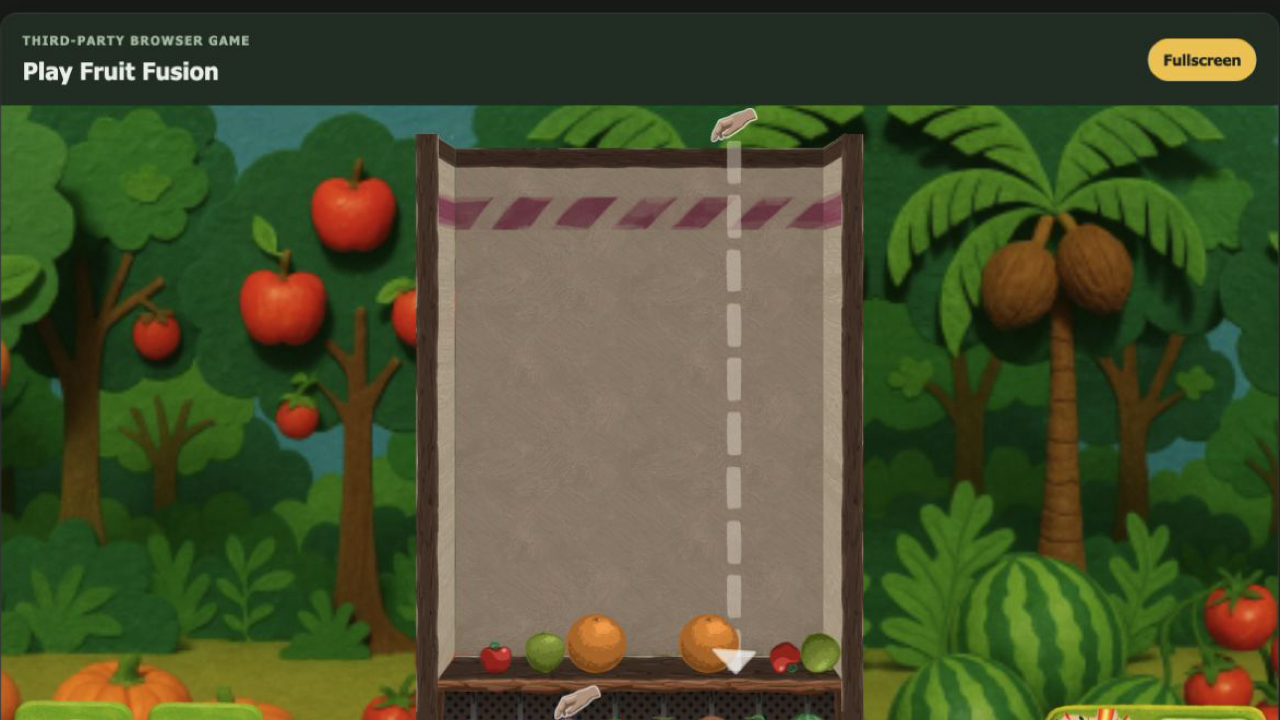
The recorded desktop run included twelve deliberate mouse-driven drops after the opening provider advertisement was skipped. Matching pieces collided and merged several times, larger fruit occupied visibly more horizontal space, and the live score reached 3600. No restart was needed during this short opening sequence. The final board contained small cherries and green fruit alongside larger orange fruit, making the tradeoff between scoring and usable space directly visible.
This evidence supports the guide's central claim that placement is not only about making the next pair. Every successful merge changes the geometry of the container. The score change confirms progression within the core loop, while the growing pieces explain why a locally successful drop can still make the next decision harder.
Limits and reader decision
The check lasted about two active minutes on desktop Chromium with mouse input. It did not reach a game-over state, identify every fruit tier, test boosters, compare restart behavior, evaluate long-session balance, or verify mobile controls. It also cannot guarantee which provider advertisement a reader may encounter later. Choose Fruit Fusion if repeated drops, visible score growth, and increasingly tight board space sound appealing. Skip it if you need a story, verified touch play, or an exhaustive analysis of the later progression curve.